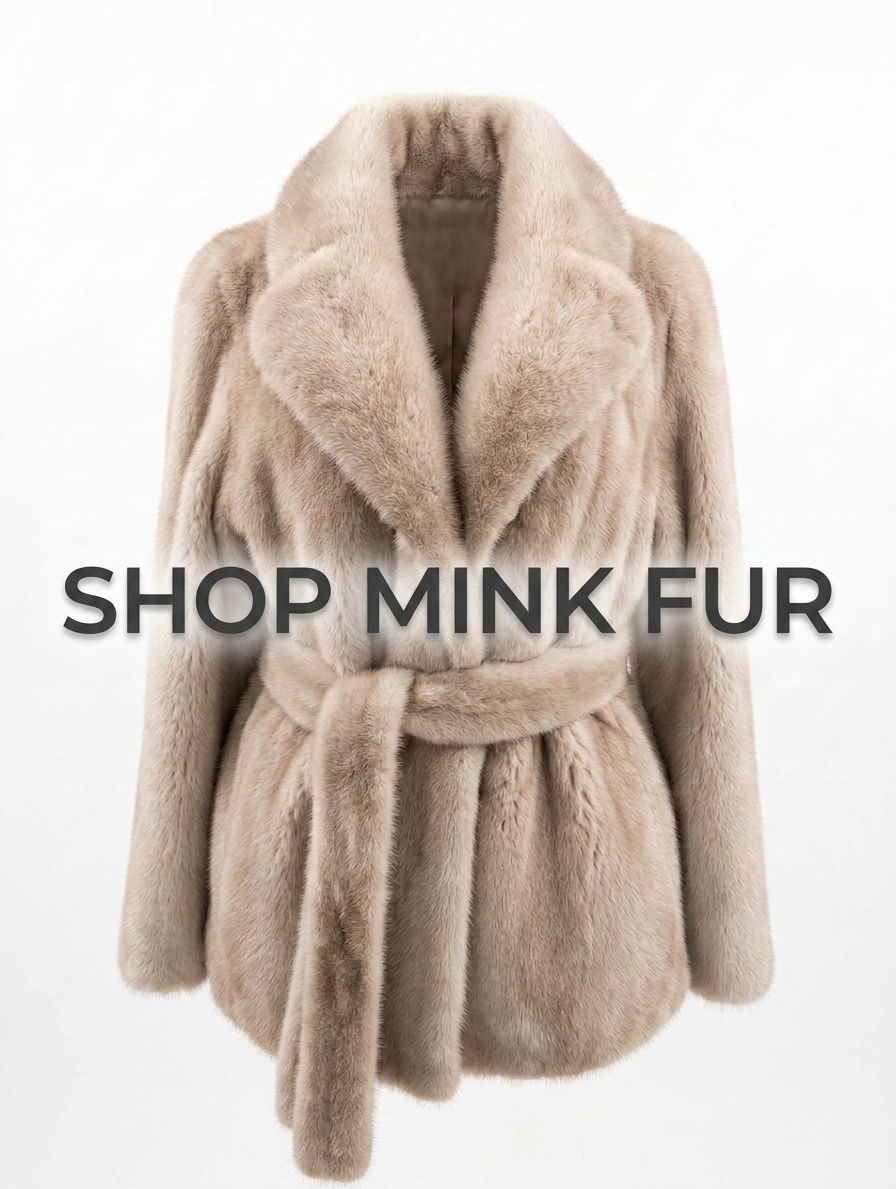
Mink Fur Jackets: History, Value & Prestige
The story of mink as a luxury material begins in North America, where the animal was first trapped by Indigenous peoples and early European settlers for warmth and trade. By the 17th and 18th centuries, the fur trade had become one of the most lucrative industries in the New World, with beaver and mink pelts commanding enormous prices in European markets.
It wasn’t until the late 19th and early 20th centuries that mink truly became synonymous with high fashion. As the fur trade industrialized and mink ranching emerged in the 1860s–1880s, supply grew — and so did demand among the wealthy elite. By the 1920s and 1930s, a full-length mink coat had become the ultimate symbol of wealth and glamour, draped across the shoulders of Hollywood actresses, socialites, and royalty alike.
The post-World War II era — the 1950s and 1960s — represented the absolute golden age of mink. It was the gift a wealthy husband gave his wife, the reward of a successful career, and the uniform of the upper class. Department stores devoted entire floors to fur salons, and owning mink was an unambiguous declaration of having arrived.
Craftsmanship & Value
A quality mink jacket is a remarkable feat of craftsmanship. A single garment can require 35 to 65 pelts, each carefully matched for color, texture, and sheen. Skilled furriers spend dozens of hours cutting, stretching, and sewing the skins together so that seams are virtually invisible and the fur flows as a single, seamless surface.
Several factors determine a mink’s value:
• Breed & Origin — Scandinavian mink (Danish, Finnish, Swedish) is widely considered the finest in the world, prized for its exceptional softness and lustrous sheen. American and Canadian mink are also highly regarded.
• Color — Natural colors range from deep brown to pale platinum and pure white. Rarer colors — black cross, sapphire, and white — command premium prices.
• Pelt quality — Silkiness, density, and uniformity of the underfur are critical markers of quality.
• Cut & construction — A masterfully constructed jacket from a renowned furrier holds its value far better than mass-produced alternatives.
Historically, a fine mink jacket ranged from a few thousand dollars at the lower end to $20,000–$100,000+ for full-length coats from top fashion houses.
Prestige & Cultural Significance
Few garments in history have carried the social weight of mink. To wear mink was to communicate wealth, taste, and status without saying a word. It appeared in the wardrobes of:
• Hollywood royalty — Marilyn Monroe, Elizabeth Taylor, and Marlene Dietrich were rarely photographed without fur.
• Music icons — From jazz singers to hip-hop artists, mink has crossed cultural lines as the ultimate flex of success.
• Heads of state & aristocracy — Mink and other furs were staples of formal court and diplomatic dress for centuries.
The phrase “she wears mink” was cultural shorthand for a woman of wealth and sophistication well into the late 20th century.
The Modern Landscape
The prestige of mink has not disappeared, but it has grown more complicated. Animal rights movements — most prominently since the 1980s and 1990s — have challenged the social acceptability of wearing fur in many Western countries. Several fashion capitals, including London and Amsterdam, have seen major designers abandon real fur entirely.
Yet the vintage and resale market for quality mink remains robust. A well-preserved mink jacket from a reputable maker is still considered a legitimate luxury asset, and in parts of Eastern Europe, Russia, and East Asia, mink retains much of its traditional prestige.
Today, mink occupies a fascinating cultural space — simultaneously a relic of old-world luxury and a continuing symbol of opulence for those who still embrace it.
Whether admired or debated, the mink fur jacket remains one of the most storied garments in fashion history — a tangible artifact of craftsmanship, aspiration, and the ever-shifting meaning of luxury.
Iconic Mink Moments in Hollywood
The Golden Age of Glamour (1930s–1950s)
Hollywood and mink were made for each other. The film industry’s golden age coincided perfectly with mink’s rise as the ultimate luxury item, and the studios knew exactly how to use it. Costume designers and studio executives understood that draping a star in mink communicated everything an audience needed to know — wealth, power, desirability, and sophistication — in a single frame.
Marlene Dietrich
Perhaps no star embodied the mink aesthetic more completely than Marlene Dietrich. The German-born actress made fur a cornerstone of her legendary personal style, wearing it both on and off screen with an almost architectural authority. Her mink coats were not merely clothing — they were armor, projection, and seduction rolled into one. She once reportedly said that a woman without fur is a woman without ambition.
Joan Crawford
Crawford was arguably Hollywood’s most devoted mink enthusiast. She wore full-length mink coats to premieres, shopping trips, and casual lunches with equal conviction. Her relationship with fur was deeply tied to her carefully constructed public image — a girl from poverty who had conquered Hollywood and intended the world to know it. Mink was her trophy, worn daily.
Marilyn Monroe
Monroe’s most famous mink moment came not on screen but in real life — she was regularly photographed wrapped in mink coats, the softness of the fur playing perfectly against her luminous image. On screen, her roles in films like Gentlemen Prefer Blondes (1953) positioned her as the ultimate object of luxury desire, with fur appearing as a natural extension of that world. Monroe famously received mink gifts from wealthy admirers and understood their symbolic language fluently.
Lana Turner
Known as the “Sweater Girl,” Turner graduated from tight knits to sweeping minks as her career ascended. Her fur coats became as much a part of her public identity as her platinum hair — a visual shorthand for the dizzying heights she had climbed from her humble origins.
The Silver Screen’s Most Memorable Mink Scenes
All About Eve (1950)
Bette Davis and Anne Baxter both appear draped in fur throughout this razor-sharp drama about ambition and betrayal in the theater world. The mink functions almost as a character itself — a marker of who has power and who is still reaching for it.
How to Marry a Millionaire (1953)
This Marilyn Monroe, Betty Grable, and Lauren Bacall comedy is essentially a love letter to the aspirational power of luxury, with mink coats appearing as the logical endpoint of the characters’ romantic and financial ambitions. To catch a millionaire was to earn the mink.
Funny Face (1957)
Audrey Hepburn, draped in Givenchy and occasionally fur, helped cement the idea of mink as the province of the effortlessly chic rather than merely the ostentatiously wealthy — a subtle but important shift in how Hollywood presented luxury.
Breakfast at Tiffany’s (1961)
Though Audrey Hepburn’s Holly Golightly is more associated with the little black dress, fur appears throughout the film as a prop of the wealthy world she is desperately trying to enter — a symbol of the life just out of reach.
Music, Television & the Broader Cultural Stage
Judy Garland
Garland’s concert performances and television appearances throughout the 1950s and 1960s frequently featured mink stoles and jackets. For Garland, as for many performers of her era, mink on stage communicated that the show — and the star — had truly arrived.
Dynasty (1981–1989)
Television brought mink to a mass audience in an entirely new way. The ABC soap opera Dynasty became a cultural phenomenon partly on the strength of its outrageously luxurious costuming. Joan Collins as Alexis Carrington wore fur with villainous relish — mink became the visual shorthand for a certain kind of powerful, unapologetic femininity that the show celebrated and satirized in equal measure.
Hip-Hop’s Embrace of Mink
By the 1980s and 1990s, mink had crossed cultural lines entirely. Hip-hop artists — from the Notorious B.I.G. to Jay-Z to Lil’ Kim — adopted mink as the ultimate symbol of success and self-made wealth. Where Hollywood stars had received mink as gifts from studios or lovers, hip-hop artists bought their own, and wore them as declarations of independence and achievement. Lil’ Kim in particular made full-length mink a recurring element of her bold visual identity. Mink in hip-hop wasn’t inherited prestige — it was conquered prestige.
The Legacy
The image of mink in Hollywood has never entirely faded. Vintage photographs of Monroe, Crawford, and Dietrich in their great coats remain among the most reproduced images in fashion history. Costume dramas set in the mid-20th century reach automatically for mink to establish period authenticity and convey a character’s status.
Mink in Hollywood was never just a coat. It was a language — one that spoke of desire, power, transformation, and the particular American dream that the film industry sold better than anyone else. That language may be spoken more quietly today, but it has never gone entirely silent.

