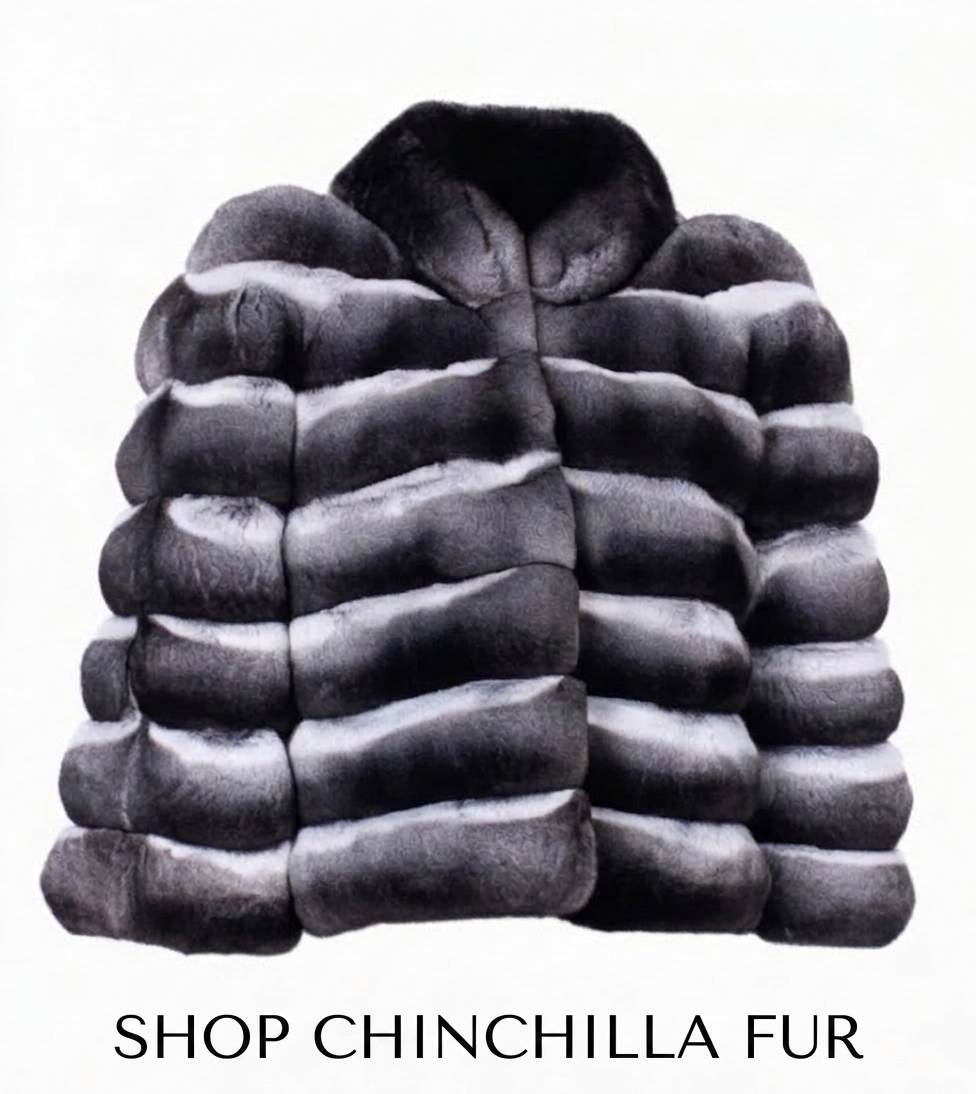
Chinchilla Fur: The Softest Luxury in the World
What Is Chinchilla Fur?
Chinchilla fur occupies a place of reverence in the world of luxury that few materials — natural or otherwise — can match. The chinchilla is a small rodent native to the Andes Mountains of South America, and its fur is widely regarded as the softest fur on earth. The secret lies in density — where a human hair follicle produces a single strand, a chinchilla follicle produces approximately 60–80 hairs. The result is a fur of almost impossibly delicate softness, extraordinary lightness, and a distinctive blue-grey color with darker veiling that makes it instantly recognizable.
It is also among the most labor-intensive furs to work with and the most expensive to produce — which is precisely why a chinchilla garment has always been the rarest and most exclusive of all fur luxuries.
Origins: The Andes & Indigenous History
Pre-Columbian Use
Long before Europeans arrived in South America, the indigenous Chincha people of the Andean highlands had been using chinchilla fur for centuries. The animal takes its name directly from this people — chinchilla meaning, roughly, “little Chincha.” The Chincha and later the Inca Empire prized chinchilla fur deeply, using it to make clothing and textiles reserved exclusively for Incan royalty and the highest nobility. Common people were forbidden from wearing it.
This early association with royalty and exclusivity was not coincidental — it reflected an instinctive recognition that chinchilla fur was something categorically different from other materials. The Inca understood what European furriers would later confirm: there was simply nothing else like it.
European Discovery (16th Century)
When Spanish conquistadors arrived in South America in the early 16th century, they encountered chinchilla fur and immediately recognized its extraordinary qualities. Pelts were shipped back to Europe, where they caused a sensation among the aristocracy. By the late 16th and early 17th centuries, chinchilla fur had become one of the most coveted luxury materials in European courts — worn by royalty and the wealthiest nobility as a mark of the most rarefied taste.
The demand was insatiable, and it would ultimately prove catastrophic for the wild chinchilla population.
The Age of Extravagance: 17th–19th Century
Royal Courts & Aristocratic Fashion
Throughout the 17th and 18th centuries, chinchilla fur appeared in the wardrobes of European royalty as the most precious of all furs. Unlike sable, which was associated primarily with Russian imperial power, chinchilla carried an exotic mystique — it came from the remote, almost mythical mountains of South America, which only added to its allure.
The fur appeared in state portraits of European monarchs, trimming robes and cloaks as a visible declaration of wealth and status. In the court of Louis XIV of France — the Sun King, who elevated luxury to a state philosophy — chinchilla fur was among the most sought-after materials in the royal wardrobe. The French aristocracy’s passion for chinchilla helped establish Paris as the world capital of luxury fur craftsmanship, a position it would hold for centuries.
In England, chinchilla fur trimmed the robes of nobility and appeared in the formal dress of the court. Its pale blue-grey color was considered uniquely elegant — more subtle and refined than the deep browns of mink or sable, lending it an almost ethereal quality that appealed to the most sophisticated tastes.
The Birth of Chinchilla Ranching
Mathias F. Chapman & the First Ranch (1923)
The story of modern chinchilla fur production begins with a single remarkable American engineer named Mathias F. Chapman. Working as a mining engineer in Chile in the early 1920s, Chapman became fascinated with chinchillas and conceived the idea of breeding them in captivity for their fur.
What followed was an extraordinary undertaking. Chapman spent three years obtaining the necessary permits from the Chilean government — which was understandably protective of its remaining chinchilla population — and then organized a team of 23 men to trap live animals in the Andes. After months of searching at high altitude, they caught just 11 chinchillas — 3 females and 8 males.
Chapman then faced the challenge of bringing these high-altitude animals down to sea level alive. He did so gradually, moving them incrementally lower over many months to allow their bodies to acclimatize. In 1923, he arrived in California with his small group of animals and established the world’s first chinchilla ranch in Los Angeles.
From these 11 animals, the entire global chinchilla ranching industry descends. Chapman’s meticulous breeding records and husbandry practices became the foundation of the industry, and he is rightly regarded as the father of modern chinchilla ranching.
Growth of the Industry
From California, chinchilla ranching spread rapidly across North America and then to Europe. By the 1950s and 1960s, ranching operations existed throughout the United States, Canada, and much of Western Europe. Breeders worked to develop animals with superior fur quality — darker veiling, more even color, greater density — through careful selective breeding.
However, the economics of chinchilla ranching remained formidable. Chinchillas are slow to reproduce — producing only one or two litters per year of one to three kits — and require meticulous care. The quantity of fur produced per animal is extremely small. These factors kept chinchilla fur at the very top of the luxury price scale regardless of the growth of ranching.
Chinchilla in 20th Century Fashion
Hollywood & High Society
By the 1930s and 1940s, chinchilla fur had established itself in Hollywood as the most glamorous of all furs — even more exclusive than mink, and worn only by the most luminous stars. Its pale, luminescent color photographed beautifully in black and white film, giving it an almost otherworldly quality on screen.
Marlene Dietrich — who as previously noted was devoted to luxury fur in all its forms — wore chinchilla with particular elegance, understanding its unique visual quality. Grace Kelly, whose personal style represented the pinnacle of refined luxury, was closely associated with chinchilla both before and after she became Princess of Monaco. A chinchilla coat on Grace Kelly was a statement of aristocratic understatement — the most expensive thing in the room worn as though it were the most natural thing in the world.
Greta Garbo, Carole Lombard, and Barbara Stanwyck all wore chinchilla in films and public appearances, reinforcing its association with a particular kind of cool, sophisticated glamour distinct from the warmer opulence of mink.
The Couture Connection
Paris couture houses embraced chinchilla enthusiastically from the 1920s onward. Jeanne Lanvin, Christian Dior, Cristóbal Balenciaga, and later Yves Saint Laurent all worked chinchilla into their most exclusive collections. The fur’s extraordinary lightness made it uniquely suited to the fluid, sculptural silhouettes that defined mid-century couture — it could be draped, shaped, and structured in ways that heavier furs could not.
Balenciaga in particular used chinchilla with architectural brilliance, creating coats and capes of almost sculptural severity that exploited the fur’s pale color and soft texture to extraordinary effect. These pieces, when they appear at auction today, command prices that reflect both their material value and their status as works of art.
Christian Dior’s New Look of 1947 — which redefined postwar fashion with its emphasis on luxurious femininity — frequently incorporated chinchilla in its most elevated expressions. A Dior chinchilla coat became one of the defining luxury objects of the postwar decade.
The Stole Era
One of chinchilla’s most iconic mid-century forms was the stole — a wide, floor-length wrap worn over formal evening dress. In the 1950s, a chinchilla stole over a ball gown was the ultimate expression of evening luxury. It required fewer pelts than a full coat, bringing chinchilla within reach of a slightly wider wealthy clientele, while retaining all of the fur’s extraordinary visual and tactile impact.
The chinchilla stole appeared at opera premieres, charity galas, and society dinners throughout the 1950s and into the 1960s, becoming one of the defining luxury accessories of the era.
The Mathematics of Luxury: Why Chinchilla Is So Expensive
The economics of chinchilla fur are unforgiving. Consider:
• A single chinchilla pelt measures roughly 10–12 inches in length
• A full-length chinchilla coat requires between 150 and 300 pelts depending on the cut and style
• A chinchilla jacket typically requires 80 to 150 pelts
• Each animal must be raised for approximately 8 months to a year before its fur reaches maturity
• Pelts must be matched with extraordinary precision for color, density, and veiling
The letting-out technique used for the finest chinchilla garments — identical to that used for sable — involves cutting each tiny pelt into strips just millimeters wide and resewing them to create a fluid, elongated silhouette. On a garment requiring 200 pelts, this can mean tens of thousands of individual cuts and seams, each made by hand.
A master furrier may spend 400–600 hours constructing a single full-length chinchilla coat of the highest quality — more than any other fur garment.
Value & Pricing
The Price Hierarchy
Within the fur world, chinchilla competes directly with Barguzin sable at the very pinnacle of the market. Depending on quality and construction, each can claim the title of most expensive fur — they occupy the same rarefied altitude, though for different reasons.
Current market pricing broadly:
• Entry-level chinchilla jacket (shorter, simpler construction) — $20,000–$50,000
• Quality chinchilla jacket (fine pelts, letting-out construction) — $50,000–$150,000
• Full-length chinchilla coat, finest quality — $150,000–$400,000
• Bespoke couture chinchilla from a great house — $400,000–$1,000,000+
The most extraordinary chinchilla pieces — vintage Balenciaga or Dior coats in exceptional condition, or bespoke contemporary commissions from the finest ateliers — have sold at auction for figures approaching or exceeding $1 million.
Price Trajectory
Like Barguzin sable, chinchilla prices have moved relentlessly upward over decades, driven by:
Absolute supply limits — Unlike mink, which can be ranched at industrial scale, chinchilla production is inherently limited by the animal’s slow reproductive rate and exacting care requirements. Supply cannot be dramatically increased regardless of demand.
Asian market growth — Chinese, South Korean, and Middle Eastern buyers have entered the top end of the chinchilla market with enormous purchasing power, driving auction prices to historic highs. Chinese demand alone has transformed the global luxury fur market over the past two decades.
Pelt quality improvements — Decades of selective breeding have produced ranched chinchillas of exceptional quality, with some breeders’ animals approaching the fur quality of the finest historical wild pelts. Top-quality ranched pelts now command prices that would have seemed extraordinary a generation ago.
The rarity premium — As with Barguzin sable, the combination of genuine scarcity, extraordinary craftsmanship, and concentrated wealthy demand creates a market where price resistance is minimal at the top end.
Color Mutations & The Breeding Revolution
One fascinating dimension of chinchilla ranching history is the development of color mutations through selective breeding. The original wild chinchilla coloring — blue-grey with darker veiling and white belly — is called standard in the trade and remains the most prized. But breeders have developed numerous color variations including:
• Black velvet — Deep charcoal to near-black, with extraordinary depth
• White — Pure or near-white animals, extraordinarily rare and valuable
• Beige & pastel — Warmer tones that appealed to different fashion sensibilities
• Violet — A rare, sought-after mutation with a subtle warm undertone
• Sapphire — A distinctive blue-grey variant
These mutations opened new creative possibilities for furriers and expanded the fashion vocabulary of chinchilla fur. A pure white chinchilla jacket is among the rarest and most expensive fur garments it is possible to commission.
Chinchilla Today
The Auction World
The world’s finest chinchilla pelts are traded through international fur auctions, most notably Copenhagen Fur (before its 2021 closure following COVID-related mink culling controversies) and various specialized auctions. The top lots — the finest matched collections of standard or black velvet pelts — consistently attract the highest prices in the global fur market.
The Collector & Vintage Market
Vintage chinchilla garments from the great couture houses — particularly Balenciaga, Dior, and Givenchy pieces from the 1950s and 1960s — are now treated as collectible works of art. When such pieces appear at major auction houses like Christie’s or Sotheby’s, they attract serious collectors alongside fashion historians and museum curators. The intersection of supreme material value and couture artistry makes them unique objects in the luxury world.
The Enduring Mystique
Chinchilla fur carries a mystique that five centuries of history have only deepened. It began as the sacred textile of Andean royalty, crossed oceans to drape the courts of European kings, nearly vanished from the earth through human greed, was saved by the ingenuity of a single engineer and eleven small animals in the California hills, and emerged into the modern world as the softest, rarest, most labor-intensive luxury garment material in existence.
To wear a fine chinchilla jacket is to wear something that connects directly to all of that history — to the Inca nobility in the high Andes, to the glittering courts of Versailles, to the golden age of Hollywood, and to the master furriers who spent months of their lives creating something that defies any ordinary standard of luxury.
In a world saturated with goods that claim to be luxurious, genuine chinchilla fur remains one of the very few materials that simply is — beyond argument, beyond comparison, and beyond imitation.

